

I get this question all the time: How did The Divine Dance come to be? The truth is, I didn’t set out to co-author a book with Richard Rohr. I set out to ghostwrite one.
I’d been a Richard-audio junkie for years, like many a deconstructing post-evangelical who was searching for streams in the desert. And I’d noticed that his Center for Action and Contemplation often hosted conferences a year or so before a book of the same title appeared. In the publishing field, where I’ve worked since 2004, this is typically a ‘tell’ that an author is working with ghostwriters, basing titles off their live-talk transcripts. So when my friend and publishing mentor — the late Don Milam, at Whitaker House — told me that he’d wanted to publish something of Richard’s ever since Richard’s Falling Upward: A Spirituality for the Two Halves of Life had been so meaningful to him during his first wife Micki’s death from cancer, I wanted to help this happen. I specifically wanted to work with Richard’s Trinity material from two conferences in the early 2010s, The Shape of God and The Divine Dance, because I thought the material was, well, revolutionary and evolutionary for how we conceived of God, the universe, and each other.
So I made the introduction — I’d known Richard since our mutual involvement with both Soularize and the early years of the Wild Goose Festival — and offered to turn his Trinity gems into a manuscript. Richard informed me that, contrary to my assumption, he didn’t normally use ghostwriters; he’d tried it and hadn’t loved it. “But I like you, Mike,” he said. “Give me a few sample chapters and we’ll see.”
So I did, and he enjoyed them. After some back-and-forth between his people and Whitaker House, the project was greenlit. I was in heaven, getting to work with some of the most potent but spiritually underreported ideas in Christian history. As I built the full manuscript from Richard’s transcripts I took some liberties, weaving in my own Trinitarian experience and study (including my involvement with editorial feedback and initial publicity launch of Paul Young’s paradigm-shifting novel The Shack: When Tragedy Confronts Eternity) and figuring Richard would cut whatever didn’t ring true. He cut less than I expected. When he read the draft he said I’d added enough original material that he didn’t want me to be an anonymous ghostwriter; he wanted me on the cover. The publisher agreed, in a manner of speaking, and that’s how I came to be the “with” at the bottom. The fine-print guy. Little Richard, a festival-goer once quipped.
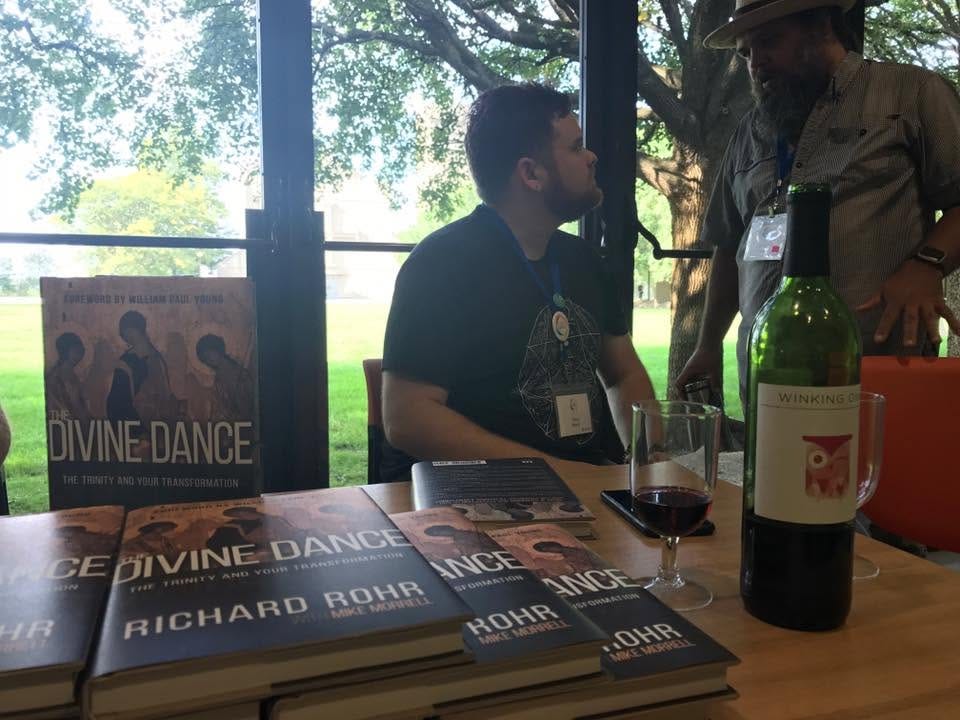
And now it’s been a decade. The world has changed a lot since 2016, and so have I. Ten years on, I’m still proud of The Divine Dance; most of what we said I’d say again today, with my whole chest.
Early on, Richard and I wrote:
“Whatever is going on in God is a flow, a radical relatedness, a perfect communion between Three — a circle dance of love. And God is not just a dancer; God is the dance itself.”
I stake my life on this. And in framing this, we gave an accurate diagnosis of the human condition:
“The greatest dis-ease facing humanity right now is our profound and painful sense of disconnection—disconnection from God, certainly, but also from ourselves (our bodies and True Selves), from each other, and from creation. We see this in political corruption, ecological devastation, war and violence, fearing and even hating each other because of our differences, whether race, religion, or sexual orientation. Our world needs to be reminded of our interdependence and our inherent union with what is.
[We] believe the Trinity can teach us how to live in creative collaboration, valuing and honoring our differences while also serving each other with humility and compassion. The Divine Dance is a meditation on how we can begin to live into a new reality based on connection instead of alienation, objective relationship instead of private autonomy. ‘In the beginning is Relationship,’ Trinity proclaims.”
And we were spot-on in taking seriously the great 20th-century theologian Karl Rahner’s lament that if the doctrine of the Trinity simply vanished from Christian life tomorrow, most Christians wouldn’t notice.
Our invitation still rings true: you’re not a passive observer of this Flow; you’re already caught up in it, whether you realize it or not. So get to realizing it!
Even so — and I’m only speaking for myself here — I want to tell you honestly where I’ve grown, and where I’ve been corrected (sometimes even kindly).
The Word We Misheard
Here’s how Richard and I framed the journey we’d take readers on:
“At the heart of Christian revelation, God is not seen as a distant, static monarch but — as we will explore together — a divine circle dance, as the early Fathers of the church dared to call it (in Greek perichoresis, the origin of our word choreography). God is the Holy One presenced in the dynamic and loving action of Three.”
Yes, yes; to the essence of this, yes. But…the parenthesis is wrong. There are two Greek verbs that sound almost identical: perichoreuō means “to dance around,” while perichōreō means to go around, to contain, to make room, even to permeate. The Fathers’ word, perichōrēsis, comes from the second verb, and choreography comes from a different root entirely. What’s more, the noun didn’t get applied to the Trinity until roughly three centuries after the Cappadocians I’m about to introduce. It first turns up in the seventh century, and in the eighth John of Damascus made it a technical term, describing the Father, Son, and Spirit as dwelling within one another, having their being in each other without mixture or confusion. Scholars usually English it as mutual indwelling (or coinherence, when they’re feeling Latinate).
Now, we weren’t the first to make this leap. Catherine LaCugna, whose work I love and will come back to, popularized the “circle dance” gloss in her magisterial 1991 tome God for Us: The Trinity and Christian Life, and even she conceded the philological warrant for it was “scant.” Plenty of us ran with it from there. Theologian Riyako Cecilia Hikota, in her careful article Beyond Metaphor: The Trinitarian Perichōrēsis and Dance puts it precisely: some people “have actually misunderstood the Greek noun perichōrēsis to come from the verb perichoreuō, thus wrongly affirming that perichōrēsis literally means ‘dance.’” She calls the trend “a kind of modern ‘invention of tradition.’”
Fair summary. I helped popularize it.
A Holy Mishearing
So should we keep the dance at all? I think so. I’ve come to believe it’s an authentic, holy mishearing of the same underlying music.
Thomas Merton read Jacques Maritain’s Art and Scholasticism in his early twenties and got it backwards. Maritain argued that an artist needs the virtues proper to the craft, things like line and color and meter, and doesn’t necessarily need to be a virtuous person; Merton concluded the opposite, writing that “the presence of virtue in the workman is necessary to the goodness of the work.” In Paul Elie’s words, “by a strange and telling misreading, Merton grasped Maritain’s argument inside out,” and came to believe that if he wanted to be a great artist he’d have to become a good man, maybe even a holy one. He was textually wrong, and that wrongness sent him to a Trappist monastery in Kentucky. Most of what American Christians know about contemplative prayer flows downstream of this misreading. Elie describes that generation of American Catholic writers as “misreading their precursors with their lives.”
Western esotericism scholar Wouter Hanegraaff frames the dilemma well. Should scholars be in the business of recovering “the authentic tradition” and exposing every modern distortion, or should we accept that spiritual traditions grow through a continuous stream of “creative (or productive) misunderstandings”? His answer keeps me honest, because he refuses dualism: to show how a tradition has been transformed, “one must be able to uncover the original as well, for otherwise there’s no possibility of comparing the former with the latter.” Which means you can only creatively misread a tradition you’ve actually read. Otherwise you’re just making things up. So I’m letting authentic etymology be what it is, while inviting the dance with my eyes wide open.

From the place of the both/and, each meaning is beautiful. When we start with the authentic Church Mothers’ and Fathers’ perichōreō, its most wooden rendering is making room around each other. This is closer than “dance,” but still sounds like clearing elbow space at a crowded bar! The patristic center of gravity, though, is within. Each Person contains and is contained by the others, no one getting swallowed or blurred in the process; each stays distinctly themselves, with no distance between them. To put it plainly, the Three are at home in one another. Jesus says as much in John’s Gospel, almost in passing: “I am in the Father and the Father is in me.” A few verses later he goes further, promising that he and the Father will come to those who love him “and make our home with them.” That second line is where you and I come in. If you’ve ever found yourself looking in on a party or a pew or a family table, wondering whether you’d be welcome, you know why this is such good news: Love creates space for belonging.
Even so, does a spiritual reality have to have a fourth-century vintage in order to be true? Have you experienced the dance of Trinity in and as your life? If you haven’t yet, and don’t want to lean on Richard and me alone for the verity of these cosmic rhythms, Hikota movingly quotes another intrepid innovator, none other than C.S. Lewis:
“In Christianity God is not a static thing – not even a person – but a dynamic, pulsating activity, a life, almost a kind of drama. Almost, if you will not think me irrelevant, a kind of dance… The whole dance, or drama, or pattern of this three-Personal life is to be played out in each one of us: or (putting it the other way round) each one of us has got to enter that pattern, take his place in that dance.”
Hikota also names a deeper problem with how people like me use the dance metaphor, and I take her challenge seriously. The metaphor is “meaningless,” she argues, “unless theologians try to overcome this historical bias against dance (and consequently against the human body itself).”
Jesus-followers love to talk about the divine dance (especially in the last decade, amirite?); far fewer of us move our bodies accordingly. Or if we do, we keep our Saturday nights and Sunday mornings hermetically sealed from one another!
Hikota’s constructive hope is that dance could call us toward “a more fully embodied and incarnational Christianity.” I agree with her, and I hope this series is something of an answer, since nearly everything I’m going to unfold for you happened in bodies: feet on cave floors, a friend dervish-turning badly in a courtyard, a spine and a gut and a pair of crossed arms. A hardwood floor in the woods.
The Mirror of Maybe, the Table of Yes

There’s another detail I now handle more cautiously: the suggestion that a mirror once occupied the small rectangle on Rublev’s table, inviting you in as not just a viewer, but a participant in the Divine meal. Some critics have called it into question; I haven’t been able to substantiate its art-historical basis or repudiate it. The presence or absence of a mirror is an open question for me.
But my experience of the icon’s invitation doesn’t depend on a missing piece of glass. The fourth side of Rublev’s table is already open, facing outward, three figures bent toward a cup with an empty place pointed straight toward you, the viewer. The icon draws us in either way.
Dancing Down to Our Bones
For me, the idea of Trinity as divine dance still spends as holy currency, even if it was minted more recently. And our inclusion in one of the greatest icons of all time is still real, whether its mechanism is a mirror or a place-setting. When it comes to Blessed Trinity, we’re still invited: to rise to our feet, and recline at the feast.
If I’m honest, there are two even more substantial motifs, hinted at but overall MIA in The Divine Dance’s pages, that would make our core conviction even stronger:
We introduced the dance, but we didn’t yet name the cost, or root in the body.
We had no way to say what it costs God to make space for anything (rather than no-thing), nor what it costs us to inhabit this space. And though we spoke compellingly about flow and participation, we didn’t offer a practice sturdy enough to carry the Trinity from our heads down into our limbs.
I discovered both in the same land where I found my bio-father’s family. So next time, let’s go to Turkey.
A Little Room at the Table
One theme running underneath everything you’ve just read is this: love makes space.
And, as I’ll explore more deeply next time, clearing space costs something.
That’s true in cosmology. It’s true in relationships. And, less poetically but no less actually, it’s true of making things like this.
Since At Home in One Another — the first installment of The Divine Dance at Ten — went out, a number of you have become paid subscribers, many joining for the year, and a couple even stepping forward as Holy Fools. As someone who’s supported other authors my entire vocation but who has, improbably, just begun stretching his authorial wings directly, I’m genuinely touched.
Because what you’re giving me isn’t simply funds. It’s room: room to read, research, write, interview, practice, and turn a quarter-century of accumulated books, friendships, experiments, mistakes, and occasional holy mishearings into something more coherent and useful for us now.
Most of what I write here will remain free; I want you to pull up a chair regardless.
But if this work is feeding you, and you’d like to help me give it more of my vocational attention, becoming a paid subscriber is the most direct way to do that.
And since my birthday is now only six days away, the slightly ridiculous Holy Fool Charter Member birthday special is still alive: through October 30, U.S. readers who join at $100 or more will receive a signed copy of The Divine Dance in the mail — personalized if you’d like, shipping on me. Canadian friends, the threshold is $200 because international postage has apparently joined the principalities and powers. Elsewhere in the world, write me and we’ll figure something out.
Ten years after this book appeared, I’m grateful to still be discovering the unforced rhythms of grace.
And grateful to have you at the table.

PS: Rainier Wylde and I had a blast at Soularize and Theology Beer Camp! It was a treat getting to meet several of you on-site; I won’t forget the stories you shared with me. Ridiculously, Rainier and I got zero pics together on the trip (living in the moment rather than documenting it, I guess), but I did snap one with Dr. Tamice Spencer-Helms, who was also at both gatherings with us! Be sure to check out their Substack, Black Modern Mystic, and their powerful book, Faith Unleavened: The Wilderness Between Trayvon Martin & George Floyd.

Maybe you didn’t get to see Rainier and me on our little midwest tour, and you’re bummed about that. I get it. Well, you’re in luck, ’cause we’re doing it again! Create Yourself Alive happens in just over a week, November 2-3 in beautiful Charleston, South Carolina. It’s not too late to join us, you impulsive rascal, you.
After all, it’s two days set aside to find out what happens when you clear your calendar and dedicate yourself to the creative life now, struggling against what Gurdjieff called the disease of tomorrow. It’s an immersion made for people who want to take the leap and take their creativity seriously. Each day will be about 6-7 hours filled with conversation, hands-on breakouts, a few of us holding space, and practical exercises. There will be time to work alone and time to share what you’re making with others. We’ll eat together, play, and most of all — create.
Maybe you’ve had a book you wanted to write in your head for years. Maybe you’re halfway through something and you can’t seem to finish. Maybe you’ve been so busy helping other people, meeting their needs, that you’ve lost touch with what you wanted to make.
You don’t have to be a professional artist or writer to be a part of this. Nah. You just have to bring your willingness to participate. Our aim is for you to leave with something finished and the tools to keep going when you get home.
Come spend November 2-3 with us. Give the creation you keep dreaming about some air to breathe in your actual life.

Cuddle party instead of dance?
Becoming God happens
when we get our
elbows and knees
just right for snuggling
except that it’s
billions of bodies and
nobody has deodorant
and everyone is farting
with growling tummies
but we find our bones
starting to slide into
alignment so that
we tickle and rub
together with no less
innocence than a
meadow of flowers
and we stop saying
mine about anything
since all of it really
can be all of ours.
When all our bodies fit
like a jigsaw puzzle
and no one remains
outside the circle,
when our eyes turn
into mirrors of smiles
that ripple like sunbeams
dancing over the sea,
when earth is not
different than our skin
and we stop building
a world without dirt,
when we no longer
try to steal land or
climb to the top or
outhustle everyone else,
when glory is all
that we see in
our field of vision
and we trust its magic,
when we hold hands
every time we pray
and make sure no one
falls asleep without kisses,
then we will be God
not because we can
do anything on our own
but because God is
the giant cuddle pile
that never stops drawing
bodies into its warmth
just like the protozoans
who worked patiently
over billions of years
to cuddle their way
into human bodies.
One day we will be
galaxies glowing in
perfect belonging and
hell will finally be empty.
Hi....I would like to recommend a profound work on the Trinity which I believe you would find entirely congenial--it is Eugene Webb, In Search of the Triune God. He compares the speculative approach of the Latin West to the East's understanding of the relational trinity as that in which the Christian subject participates; the relational trinity points us toward "life in Christ" as our belonging to that "dance." Gene's work deserves a much wider audience!!