

Konya: The Day the Master Met Someone
I can’t really talk about the Trinity without talking about Rumi. Which might sound odd, but the divine dance pervades both. Let me explain.
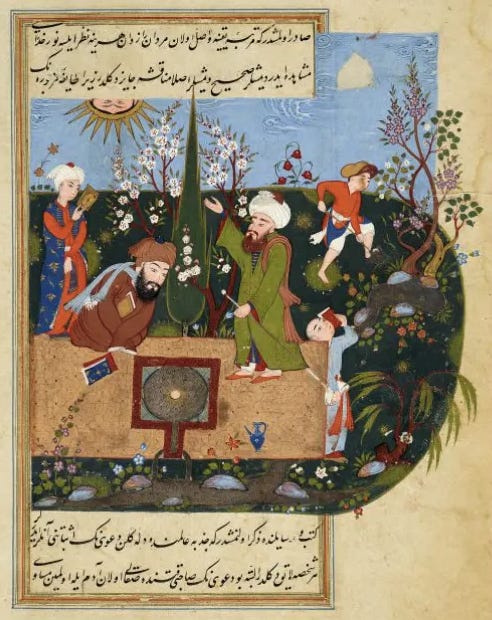
About midway into our pilgrimage through Turkey we drove south to Konya, the city Rumi called home. In the thirteenth century Konya was one of the busiest commercial and cultural crossroads of the world, and one of its best-known religious authorities was a man named Jalal ad-Din, whom everybody called Mawlana, “our master.” He was a jurist, a legal scholar and preacher well known in the city while still in his twenties: serious, respectable, the consummate insider. Then in 1244 a wandering dervish named Shams of Tabriz walked into his life and set it on fire.
Later legends make Shams into a wild man, an unlettered holy fool who blew into town to wreck the professor’s tidy world. But is this true? William Chittick, who translated Shams’s recorded sayings into English, says the hagiography “makes Shams out to be a spiritual genius, contemptuous of book learning and ignorant of the Islamic sciences,” but that “there is little basis for this view.” In reality, Shams knew the Qur’an by heart, had studied jurisprudence (fiqh, Islamic law), and kept company with jurists. So the “Konya Singularity” was two scholars meeting, and one of them setting the other on fire. Dr. Omid Safi framed it perfectly while guiding our group; I scrawled it in my journal: “How did a nerdy law professor become Rumi? He met someone.”
A Lover Is Something Else Entirely
Shams can be prickly in his recorded sayings, but every so often he says something that stops me cold. Speaking of his own father, he observes: “A good man is one thing, a lover something else.” That’s the missing ingredient Shams provided. Rumi was already a good man; after Shams he became a lover, and one of the great poets of any language, pouring out tens of thousands of verses, many of them addressed to his friend. Here’s one reaching toward the nearest of intimacies, from Omid’s Radical Love: Teachings from the Islamic Mystical Tradition:
“Faithful friend
come
come closer
Let go
of ‘you’ and ‘I’
Come
quickly
You and I
have to live
as if
you and I
never heard
of a ‘you’
and
an ‘I’”

Elsewhere, still testifying to this world-shaping friendship, Rumi confesses (again in Omid’s luminous translation):
“My soul screams out
‘what love! What fire!’
This fire
the water of life
is intimate with you
Wish I could borrow a hundred eyes
to keep them all
glancing at you
Where to borrow
such eyes?
Who today casts
such love-glances?
The earth is illuminated
through your face
as if
there are a thousand suns and stars
in the sky
I am ashamed of love
to call you a mere human
I fear God
to call you divine”
Here is the masterful one with a jurist’s mind and a poet’s tongue, torn between feeling it slander to call his beloved merely human, but trembling within his every pious instinct to name his dear companion as he hopes (and dreads) he might be: actually divine.
I want to tread carefully here, because I’m a guest in this material. Rumi was a Muslim, among the most exacting of monotheists, and I’m not going to conscript him into a doctrine he’d have rejected; he wasn’t a Trinitarian. But he knew something the Cappadocians knew:
There is a Reality living between persons, not reducible to either of them and not less than God.
Parted From the Reed-Bed,
Alive Because We’re Breathed Through

Rumi’s great six-volume spiritual epic, the Masnavi, opens with the song of the same reed flute I’d heard in the caravanserai. In Jawid Mojaddedi’s rhyming rendering for the Oxford World’s Classics edition:
“Now listen to this reed-flute’s deep lament
About the heartache being apart has meant:
‘Since from the reed-bed they uprooted me
My song’s expressed each human’s agony,
A breast which separation’s split in two
Is what I seek, to share this pain with you:
When kept from their true origin, all yearn
For union on the day they can return.’”
The reed has been harvested from the marsh where it grew, hollowed out and pierced with holes, and that’s precisely why it can make music; its song is the sound of longing for its source. I don’t know how an adopted kid is supposed to read Since from the reed-bed they uprooted me without getting a lump in their throat.
Annemarie Schimmel, one of Rumi’s foremost modern interpreters, connects the image to the Qur’anic account of God breathing divine breath into the first human. We are, she says, ‘the flute which speaks when touched by the breath of the Divine Beloved’: hollowed and therefore musical, longing because we’ve been separated, alive because we’re breathed through.
“The Trinity” Written Across the Page
I only noticed this recently, rereading my journal from that trip. Omid had been weaving these profundities around the Sufi ‘glance’ of love one afternoon, and at the top of the page where I took notes on his gentle lecture (a lecture, mind you, on Islamic mysticism, in Turkey, by a Muslim scholar) I’d written in capital letters: THE TRINITY. A few pages earlier I’d copied down a line of his, “Not oneness, but one-ing,” proposing that union isn’t a static fusion but an ongoing activity, a verb. And on another page, from a teaching in Istanbul, I’d jotted something down without any idea what I was writing:
“Presence is about our presence, not God’s steadfast presence. Our heart in our feet.”
I’ve spent the decade since The Divine Dance: The Trinity and Your Transformation seeking to live this sentence. God’s presence isn’t what’s in question, as much as it can feel like it; the question is whether I show up, whether my heart makes it all the way down into my feet.
Simone Weil taught me that paying attention (an almost throwaway phrase whose meaning I spend most of my days convinced that I already grasp) is the surest way to show up: to the Beloved, to those I say I care about, to this precious planet, to my own life.
“Attention, taken to its highest degree, is the same thing as prayer. It presupposes faith and love.
Absolutely unmixed attention is prayer.
It is the orientation of all the attention of which the soul is capable toward God.
The quality of attention counts for much in the quality of prayer. Warmth of heart cannot make up for it.
Attention is the rarest and purest form of generosity.”
(from her Waiting for God and Gravity and Grace)
Kneeling at the Shrine of Shams
In Konya I approached the shrine of Shams, a short walk from Rumi’s tomb, yet a world away. Rumi rests under the turquoise Green Dome, now Turkey’s most-visited museum, drawing more than three million visitors annually. Shams lies (it is said) in a squat stone tomb about twenty-three feet square, beside a modest mosque in a city park. We wouldn’t have even been able to get in if it weren’t for Omid, who (as my adoptive Italian/New York family would say) knows a guy. Nobody knows who built Shams’ humble resting place, and nobody can say for certain he’s even buried there; Tabriz and Multan claim him too. Yet the old Mevlevi custom was to visit Shams first, then pause at a spot between the two shrines they called ‘the meeting of the two seas,’ as if the friendship itself deserved a station of its own.
And so I knelt there, considering every holy friendship I’d been given. And how the cleanest-burning bonds carry a signature neither friend placed there. Do you know the kinds I mean? The ones where what’s alive between you is so clearly not contrived by either of you, and the only honest acknowledgment is that a Third was present. I considered these dear friends — including Aline, who dared accompany me on this voyage — with deepening joy.
I don’t think that was mere sentiment; it was data for me: The sacred strangeness of a Cappadocian claim turning up in a Muslim shrine. The realest thing about us is the living relation that holds us both — two friends at home in one another, and something holy at home in them.
Spirit-Striking at the Goldsmiths’ Bazaar
So how did the whirling begin? You know, the distinctive turning we discussed last time up north in Cappadocia, the kinetic visual that most people think of when they even consider Islamic mysticism, aka Sufism. And frankly, what comes to my mind and heart when I consider a Divine Dance, so much so that I commissioned the brilliant Andy Ristaino to bake it into my new icon for this whole Mycelial Movement for Mystics & Misfits I’m hoping we forge, together:

In the pages of The Triumphal Sun: A Study of the Works of Jalāloddin Rumi, Schimmel passes a story along about how this whirling began. Rumi is walking through the goldsmiths’ bazaar in Konya and passes the workshop of a goldbeater named Salahoddin Zarkub. He hears the rhythmic hammering, the sound of a man at work, and he begins to turn right there in the market. He pulls Salahoddin out of his shop and the two of them dance in the bazaar for a while, until Salahoddin, bless him, goes back to work. Because after all, he has a business to run.
But Rumi keeps whirling for hours.
The dance began with the sound of somebody working, and we’ll be in a flooded fellowship hall in western North Carolina before this tale is through, so keep that in your pocket.
Schimmel adds another detail I treasure: Rumi was so given to the turning that he was known to issue legal rulings, fatwas, while whirling. The law professor never stopped being a law professor; he just started doing it in motion. (I find that the easiest way to ‘true’ our spirituality is to observe how it shows up in our daily lives.) She also shows how completely Rumi understood the scope of this kinetic Love. She paraphrases him asking:
How would the hidden breeze that keeps the world alive ever become visible if no dust were stirred up?
If the leaves in the garden didn’t dance?
Nothing is outside this dance.
Rumi even borrows an old Persian idiom for this Dance’s range, az māh tā māhī, “from the moon to the fish”: from the reaches of the heavens to the depths of the sea, and everything in between.
With, in, and (as Rumi dared ponder) as — this Dance pervades everything. Her steps are All in All.

Next time: We meet the choirboy from Kars who gave us a spirituality for the bazaar rather than the monastery, where life’s struggle isn’t an anomaly to be avoided but a feature to be embraced.
Tomorrow’s My Birthday!
First, a tiny mea culpa.
A kind reader wrote me this wanting to become a Holy Fool at $150 — and discovered that I’d accidentally configured the tier so the only option was the full $222. Whoops. That’s fixed now. So if you tried to join and Substack wouldn’t let you select your amount, my apologies. The Holy Fool door is now open to choose your own adventure.
And the timing feels strangely fitting after writing this installment.
Simone Weil called attention “the rarest and purest form of generosity.” This week, you’ve been extraordinarily generous with your attention: The Evolutionary Revolutionary somehow climbed to #6 Rising in Faith & Spirituality on Substack. Whaaa? Thank you. Truly.

I’m also grateful to those of you who have supported me by becoming paid subscribers this week. You buy me the time to follow Rumi down obscure scholarly rabbit holes, reread decade-old travel journals, speaking with remarkable friends, and gather what I find back here — hopefully with my heart making it all the way down into my feet.
And since tomorrow is my birthday, my Holy Fool Charter Member special is still on through October 30: contribute $100 or more in the U.S. and I’ll send you a signed, personalized copy of The Divine Dance, shipping included. Canadian friends, $200; elsewhere, write me and we’ll improvise.
Free, paid, Holy Fool — I’m so glad you’re here.
After all, Rumi became Rumi because he met someone.
I’m increasingly convinced none of us becomes ourselves alone.
PS: Did you read my travel accounts this week wishing you could have an adventure with Omid? Well, he’s leading one of his illuminated tours very soon, November 22-28. It’s not in Turkey, but it’s a Rumi Retreat, in Marrakech, Morocco. There are a couple spots left if you’re wanting to join. Check it out.
PPS: It’s last-call for Create Yourself Alive, happening November 2-3 in beautiful Charleston, South Carolina. It’s not too late to join Rainier Wylde and me.
It’s two days set aside to give yourself and your creations the absolutely unmixed attention you deserve. Each day will contain unhurried hours filled with conversation, hands-on breakouts, a few of us holding space, and practical exercises. There will be time to work alone and time to share what you’re making with others. We’ll eat together, play, and most of all — create.
Come spend time with us.

Of course they will call you a heretic for this…welcome to the Way of the Wild Christ.
The Mysterious Third in every relationship that neither can create alone...
Thank you