


In May 2015 I spent eleven days traveling through Turkey with someone who became my friend: Omid Safi, one of the world’s leading scholars of Islam and Sufism. Omid gently guides small groups in illuminated tours through sacred inner and outer journeys around the world. I knew I was walking through my newly discovered hereditary homeland, though I didn’t yet know how close I’d come to ancestral ground beneath my feet. I thought I was a pilgrim; I was also, it turns out, a descendant.
Cappadocia is one of those places that makes more conventional landscapes feel seriously under-imagined. Across the Anatolian valleys rise these improbable spires of pale volcanic rock known as tufa, sculpted by wind and weather into a landscape that looks like the Hebrew prophets’ stomping grounds by way of Dr. Seuss. They’re called fairy chimneys, and into this peculiar terrain generations of monks, hermits, and other Way-farers burrowed their homes and places of prayer. Church buildings, chapels, and cells scarcely large enough for a grown human to lie down in are carved into the landscape; even the refectories, where monks ate together, have tables and benches carved right out of the living rock.
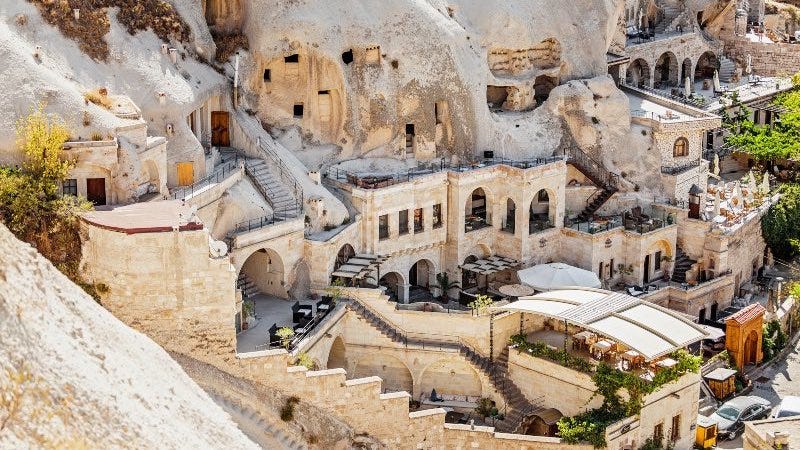
We stayed in a cave hotel in Ürgüp (like you do), and by day we wandered into chambers where people had given decades of their lives to seeking God. Imagine: someone spending sixty years in a space not much larger than a walk-in closet, offering their attention to the Sacred. And here I was, sixteen centuries after the great communitarian philosopher-mystics, enjoying the benefits of indoor plumbing while trying to feel my way into their world.
Running my fingers over one of those chapel walls, I found myself thinking about the message these Cappadocians sought to transmit, their own way of effing the ineffable. What the earliest apprentices of Jesus called kerygma (proclamation) and didache (teaching), and what later generations called doctrine — not a word that generally inspires warm feelings in my post-evangelical heart. But what if life-giving teaching is more like tufa? Something we receive from our ancestors, yes, but also something we’re invited to work with, even inhabit: malleable enough to make space for a life, enduring enough that others might find shelter there centuries after we’re gone.
This is all rather different from the dogmatic fortresses many of us grew up learning to defend. And I wonder if the Cappadocians, in their own way, weren’t inviting us to become spiritual artisans rather than theological border guards.
You may have encountered the usual Cappadocian suspects (if ya nerdy): Basil of Caesarea, his younger brother Gregory of Nyssa, and their friend Gregory of Nazianzus, whom subsequent generations honored with the rather sweepingly singular title of the Theologian. (Is that what Prince was going for in his rebrand as The Artist? Imagine being introduced at a party as Gregory, the Theologian. No pressure.)
Collectively, we remember these fellas as the Cappadocian Fathers, and for good reason: they helped give emerging Christianity a vocabulary for speaking of God that we’re still using, sixteen centuries later. But there’s someone missing from the customary lineup. Before we give the boys their due, I’d like you to meet their sister.
Macrina the Trailblazer

Her name was Macrina the Younger — “younger” only in relation to her grandmother, since she herself was the eldest of ten children. Born into one of Cappadocia’s prominent Christian families, with substantial estates near Annesi, she had every opportunity to enjoy the privileges of fourth-century aristocratic life.
Instead, Macrina seems to have been the instigator of something considerably more interesting: a community of prayer, shared possessions, manual labor, and social distinctions growing as porous as Cappadocian tufa. Her brother Basil would go on to become one of the great architects of Eastern Christian monasticism, composing rules that still shape communal religious life today. But a growing appreciation of Macrina’s own vocation suggests that he was, in no small measure, following his big sister’s lead.
I love discovering these women hiding in plain sight in the Beloved Community’s circle of care.
Gregory of Nyssa, who seems entirely willing to tell on his own brother for the benefit of posterity, recounts Basil’s return from his prestigious studies in Athens. He’d been learning rhetoric from the finest teachers of his age, and apparently came home quite taken with himself. Gregory describes him as “puffed up beyond measure with the pride of oratory,” regarding the local dignitaries of his home province with the sort of disdain that only a newly credentialed intellectual can muster.
Macrina, you’ll be relieved to hear, was not especially impressed.
Here’s a sentence I wish I could broadcast on every Theobro’s YouTube channel:
“Nevertheless Macrina took him in hand, and with such speed did she draw him also toward the mark of philosophy that he forsook the glories of this world and despised fame gained by speaking, and deserted it for this busy life where one toils with one’s hands.”
By “philosophy,” Gregory doesn’t mean abstract speculation; he means a way of life given to prayer, simplicity, and shared labor. Macrina wasn’t content to confine this wisdom to Basil, either. Over time she persuaded their mother, Emmelia, to relinquish the customary privileges of their station and enter into common life with women who had previously served their household. Gregory tells us that these women came to live as sisters rather than servants. Think about the rearrangement of everyday relationships this would have required, in a world where social standing and household hierarchy were practically written into the stones.
And Macrina’s care extended well beyond her immediate community. During a famine, according to Gregory’s account, she took in people “left prostrate along the roadways,” nursing them back to health. This was hardly a private spiritual wellness retreat. Their prayer had consequences for who ate, who received care, and who was welcomed into the household.
By the time Macrina was dying, her younger brother Gregory had become a bishop and one of the more formidable theological minds of his century. But when he visited his sister in her final illness, he found himself returning to the student’s chair.
Their conversation — or, more precisely, Gregory’s subsequent literary rendering of it — became On the Soul and the Resurrection, a dialogue in which Macrina is repeatedly designated the Teacher. The subjects under consideration are nothing less than the nature of the soul, mortality, and the resurrection of the dead. And Gregory, who would become indispensable to Christian thinking on these subjects, places much of the deepest insight in his sister’s mouth.
Now, a historian will rightly point out that this isn’t some fourth-century Zoom transcript. Gregory was crafting a theological dialogue, not transcribing his bedside conversation. Fair enough. But that makes his literary decision all the more interesting to me: when he wanted to communicate some of the deepest mysteries of faith, hope, and love, he chose to do so through the voice of a woman whose wisdom had shaped his own.
I wonder how many churches that proudly claim Gregory’s theological inheritance would go and do likewise.
One vivid detail emerges after her death: When the women of the community prepared her body for burial, they found she’d been wearing an iron cross and an iron ring beneath her clothes. The ring was hollow, and inside it was a fragment of wood she believed came from Christ’s Cross itself. She wore it against her heart for years — and nobody knew.
I consider Macrina every time someone on the Internet complains that the contemplative life is just so much escapism. It can be spiritual bypassing if we chase rarefied inner states while eschewing our flesh-and-blood relationships, neighbors, and land, but the common-life experiment that Macrina called her blood and chosen family into was anything but escapism.
Ensouled in Two Bodies
I want to visit one more scene before we get to their spiritual breakthrough, because it sets us up nicely for what follows. When Basil died, his friend Gregory of Nazianzus gave a funeral oration remembering their student days in Athens. They knew only two roads in that city, he said: the one to church and the one to their teachers. Their friendship was so complete that, he said, “we seemed to have one soul, inhabiting two bodies.”
Have you experienced friendship like this? A shared life between a pair that neither of them owns? We’ll visit this again in Konya, nine centuries later, between two very different men.
A Turning of Phrases
So what did this remarkable family of friends (and siblings) actually do? It begins with the makeover of one Greek word: They took prosōpon, which meant mask: a painted face an actor held up in ancient theater, designed so folks in the back rows could tell the hero from the fool. It was a role adopted for a time, then set down at the end of the night. The Cappadocians took this thin, theatrical word, and — through creative misreading? — made it mean person, insisting that person is the realest thing there is.
This was revolutionary. A person isn’t a mask over some truer, more impersonal substance underneath, or a passing arrangement of something more fundamental. All the way down, the Cappadocians insisted, we are persons in relationship.
But it’s even more interesting (and messier) than that. Early Way-farers were already beginning to use person-language in recognizing Divinity in and as Father, Son, and Spirit long before these Cappadocian upstarts came along. But this theatrical overtone carried a theological hazard: Did “three persons” mean one God playing at three roles? Was Blessed Trinity a one-person show with impressive costume changes? The Cappadocians said no.
Instead they sharpened the distinction between two terms that previous generations had often used almost interchangeably: ousia and hypostasis. The first identified a singular divine essence; the second named the distinctive existence of Father, Son, and Spirit. Not three separate substances, as in some kind of tritheistic scheme. Not a solitary deity taking turns behind three masks. One ousia, three hypostaseis. They didn’t checkmate every mystery with tidy delineations. But they did give apprentices of Jesus a way to envision the Three as genuinely distinct without being divided, and united without being collapsed.
In his Third Theological Oration, Gregory of Nazianzus insists that “Father” names neither a substance nor an action, but a relation: Father is Father of the Son, relational through and through. This may seem like an esoteric distinction until you notice he’s refusing to imagine a lonely God who only later gets around to loving. Love isn’t some hobby God took up after creating us.
Catherine LaCugna, in her magnificent God for Us, calls out the philosophical stakes of this development: “Person, not substance, is the ultimate ontological category. This was the most revolutionary claim made by the Cappadocian doctrine of the Trinity.”
The late Orthodox theologian John Zizioulas takes this further in Being as Communion. The person cannot exist without communion, he argues, but neither is any communion worthy of the name if it swallows up the persons who make it possible. And he means something more definite than “relationships are important”: for him, the divine life has its source not in an impersonal substance or some cosmic law of togetherness, but in the freely loving person of the Father, who is never without Son and Spirit. I find this breathtaking: The person is neither a detached little island nor a droplet dissolving into a divine ocean.
What I hear in the Cappadocians—especially via LaCugna and Zizioulas’ cadence—is a God who isn’t an isolated being who later, on a whim, decides to create and relate to some other things. Relationship goes all the way down (just like turtles), with no lonelier layer beneath it.
Love comes first, and forms the lovers.
I want to be careful here, because I know some of you read footnotes for fun (I love you; I am you). The Cappadocians didn’t invent the Trinity, or even all its vocabulary. Tertullian was using the Latin trinitas around 200 CE; Origen could speak of three hypostases well before Nicaea. At the Council of Nicaea in 325, though, hypostasis and ousia could still be used almost as synonyms. Christian theologians had a shared confession before they’d agreed on just how to pronounce it.
LaCugna says Athanasius, Nicaea’s great defender, robustly affirmed the divine Son, but “his vocabulary was inadequate to the task” of expressing the unity of Father, Son, and Spirit. The Cappadocians did the yeoman’s work here, clarifying the distinction between one divine essence and three distinct hypostases. Basil and Gregory’s sister Macrina belongs to this story not because we can prove she drafted the Trinitarian technical formula, but because the spiritual and communal life she cultivated formed two of its most important advocates. I’m inclined to think that counts for just about everything.
One essence; three hypostases. A vocabulary etched in tufa, hotly debated, and groping toward a Mystery that outpaces our words.
Remember my observation from my adoption interview, after reuniting with my birth-parents? I’m just a unique person on my own two feet. I wouldn’t claim the Cappadocians had adoption in mind. But I hear in their grammar of communion, especially as LaCugna and Zizioulas unfold it, something that thirty-two-year-old adoptee was trying to say before he knew he was thinking theologically:
You’re irreplaceable and particular, and you become more yourself, not less, the more deeply you give yourself away in love.
Strangely Warmed
James Reho opens his pathfinding book Tantric Jesus: The Erotic Heart of Early Christianity in Cappadocia, and since I stood in the very places he describes, I just have to pass along his story. James had been in Istanbul at Hagia Sophia, one of the most storied holy buildings on earth, but felt nothing. And then:
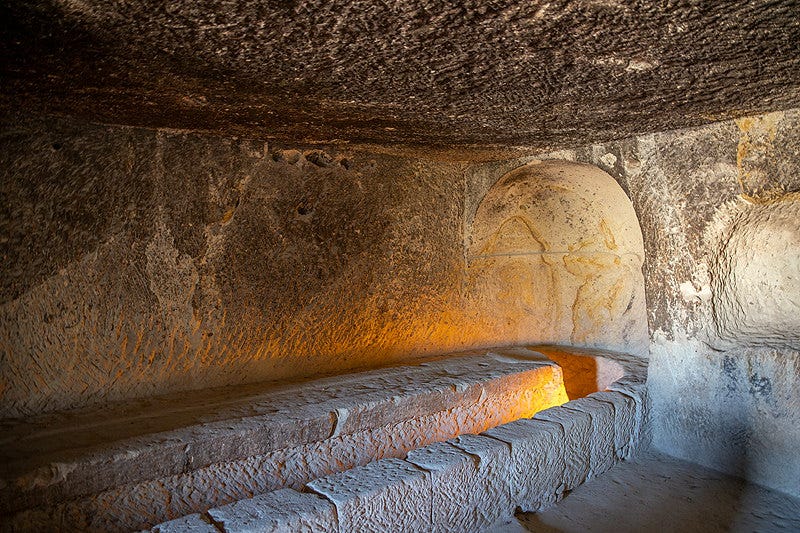
“A week later, warm in the dry heat and bright sun of the Anatolian high desert, I was climbing into the small caves inhabited by early Christian ascetics in Göreme…. The fragrance of these spiritual seekers still lingered on the cave walls and in the desert air. The dry climate of Cappadocia has preserved the crude holy icons and textual fragments they had chalked on the walls of their hollowed-out cells over a thousand years ago, making each cave a unique devotional space created through the synergy of nature and monk. Toward the end of the day, my companions and I were brought by our guide (it was mandatory to have an official guide) to one of the refectories, or dining rooms, of these early monastics. The dining room in its entirety consisted of two parallel troughs of about twenty feet in length and three feet in depth; it was a study in minimalism. The ascetics would sit on the ground, their lower legs in the trough as if they were on a chair, with the ground between the troughs serving as their dining table.
I was gripped with an urge to sit there, to take a seat at this table where so many spiritual seekers had taken their scarce amounts of food before returning to their holy work of solitude. Our guide was clear that we were to look but not touch. Being a bit of a scofflaw, I lingered toward the back of our group as the guide began to move on, waiting for him and my ten travel companions to round a bend. Then I walked straight for the refectory and sat on the ground with my legs in the trough and elbows on the table, as countless others had done before me.
Immediately, I experienced what felt like a lightning bolt coming from the ground beneath my seat and moving up through my body with speed and power. With this lightning came a revelation, which I heard from somewhere like the pit of my guts or the center of the earth: The people at the Hagia Sophia are not your ancestors. These people are your ancestors. I began to shake and felt like I was strangely overheating. Sweat poured out from every pore, and I think I blacked out for a while. I don’t remember rising from my seat.”
These people are your ancestors. James received this spiritually, and it lit his search for an embodied, incarnational faith. I’d receive the same insight a few years later, just not as a metaphor.
Playing in the Caravanserai

One evening in Cappadocia our crew drove out to the Saruhan Caravanserai, a substantial stone waystation built in 1249 for merchants traveling the Silk Road. We arrived to watch the sema, the whirling prayer of the Mevlevi dervishes, the order founded in Rumi’s memory.
(It occurred to me later that a caravanserai is an apt, if whimsical, setting for an adoptee: a place of welcome for travelers who arrived from somewhere else, bringing histories their hosts might never know. My own caravanserai, the home where I was raised, was warm and abundantly provisioned, and the innkeepers loved me fiercely. I don’t question their affection for a moment. But as you’ve already heard, there was a curious silence about the road that had brought me to their door.)
Under that vaulted stone ceiling, nearly eight centuries old, we watched the Mevlevi practitioners begin their turning. At first their arms were folded across their chests, each hand resting on the opposite shoulder, the body gathered in upon itself. Then came an opening: one palm turned toward heaven, the other toward the earth. And around they went, revolving with a stillness that seemed almost impossible from where I sat.
The symbolism was arresting, even to a relative newcomer like me. One hand receives; the other gives. Heaven and earth, blessing and bestowal, reconciled in a human body that keeps moving around its own still center. I couldn’t pretend to know what these men were experiencing from the inside, or to understand all the intricacies of their centuries-old tradition. But I could recognize something in the movement that I’d been trying to articulate with Richard: divine life as circulation, as giving and receiving, being known in the context of moving, together.
The musicians played the ney, the reed flute, and the white skirts bloomed like slow flowers.
Afterward we sat in stunned silence for a few moments. Then we stepped out into the courtyard and the dark, where someone was projecting images across the exterior walls of that ancient building: fairy chimneys and wild horses, a volcano erupting, whirling dervishes in white, Arabic letters drifting across the stone. A people’s history and movements, thrown in light onto walls their ancestors had laid.
And out there in the courtyard, my dear friend Aline Defiglia had an idea: What if we tried these steps too? Aline has a contagious way of enlisting folks in her whimsy, and tonight was no exception. She folded her arms across her chest, just as she’d seen the dervishes do, then opened them and attempted a turn. And another. There was some wobbling, a little negotiating with gravity, and a good deal of laughter as she tried to figure out where her feet belonged. Finally some of the other, more experienced pilgrims took bemused pity and showed her the motions again. A few more of us joined her.

When I called Aline recently to ask what she remembered about that night, she said it felt childlike, carefree. There was something wonderful, she told me, about watching men inside who’d dedicated their whole existence to God-realization through this precise movement, and then walking outside and just playing at it: trying it on, getting it wrong in the dark with your friends.
Doesn’t this sound like the Good News in a courtyard? Not because we were suddenly qualified to perform sema — we weren’t — or because a few wobbly turns after a ceremony are somehow equivalent to the Mevlevi’s lifelong devotion. But because a presence had crossed the threshold with us, from the sanctuary into the open air.
We’d witnessed a prayer offered with entire bodies, and instead of merely filing it away with our other travel memories, we’d allowed it to move us. Awkwardly, imperfectly, with plenty of laughter and no claim to mastery.
I could pontificate about what this means for our spiritual formation. (You know I like to gab.) But I keep returning to Aline in the courtyard, opening her arms and trying one more turn. I wonder if our capacity to enter the divine dance might have less to do with nailing every movement than with our willingness to begin.
Love makes room for beginners, whether or not we’re adept at her steps.
Until next time, Beloveds. (Buckle up, we’re about to encounter Rumi!)

One Hand Receives; the Other Gives
I keep recalling those dervish hands: one open to heaven, one open to earth. Receiving and bestowing. Nothing clenched.
That feels like a decent icon for what I’m trying to cultivate here, too.
I’m going to keep making the great majority of these letters freely available, because I want this tufa dining hall to remain wide open to everyone who’s hungry. But if these stories are feeding you — and you have the means to send a little nourishment back upstream — becoming a paid subscriber helps this work keep circulating: more time to read deeply, follow strange histories where they lead, speak with remarkable people, and bring it all back to you as practices and stories we can actually live.
And because my birthday is now just four days away, my Holy Fool birthday mischief continues through October 30: U.S. readers joining at $100 or more receive a signed, personalized copy of The Divine Dance, with shipping on me. Canadian friends, $200 because the border apparently demands tribute. Living elsewhere? Write me and we’ll improvise.
No pressure. Truly.
Love comes first, and I’m grateful that you’re here.

PS: The Good Doctor Omid is leading one of his illuminated tours very soon, November 22-28. It’s not in Turkey, but it’s a Rumi Retreat, in Marrakech, Morocco. He tells me there are a couple spots left if you’re wanting to join. Check it out.
PPS: Speaking of life-giving retreats, Create Yourself Alive happens next week, November 2-3 in beautiful Charleston, South Carolina. It’s not too late to join Rainier Wylde and me.
It’s two days set aside to find out what happens when you stop procrastinating and dedicate yourself to the creative life now. “How we spend our days is, of course, how we spend our lives,” as Annie Dillard said. Create Yourself Alive is an immersion made for people who want to take the leap and take their creativity seriously. Each day will be about 6-7 hours filled with conversation, hands-on breakouts, a few of us holding space, and practical exercises. There will be time to work alone and time to share what you’re making with others. We’ll eat together, play, and most of all — create.
Come spend November 2-3 with us. Give the creation you keep dreaming about some space to come alive.

Wow! What a jam packed article!! This was a delicious spiritual breakfast! Thank you for the time and love you put into it. 💖🙏🏼
I put this telling of Macrina the Younger right up there with the first, known composer to be written of, Hildegard of Bingen.
Great saints and theologians LEARNED at the tutelage of DEVOTE and DEDICATED women of faith. This piece blessed me. Thank you!